This page is based on a thread I made on Bluesky and duplicated to Tumblr. It has been updated far more than either of those posts, however. And I'll admit it goes on a bit long in some places now! Apologies for the ramblings and aimless thoughts, it's just how theories go sometimes.
---
In honor of a twitter thread hosted by Teame-koʊfan非公式企画 (run by the artist wncky, aka サトヱ), I've made a list of guesses for what each of yorudas hieroglyphs represent.
Like that original thread, I encourage others to share their own guesses, feel free to use the guestbook for this purpose.
Each glyph has a corresponding letter in the English alphabet. The organized rows of them that appear on Page 2 of the Official e-koʊ Guidebook denote which is which.
The rule, with only one confirmed exception, is that each hieroglyph will depict something beginning with that English letter. But it's also worth remembering that Japanese language still plays an important role in the interpretation.
Some of the English words selected could derive from Kanji with synonyms and associations (typically listed out in a Japanese-to-English dictionary) that native English speakers may not think of.
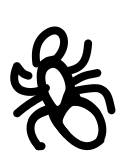
Best Guess - Ant「蟻」
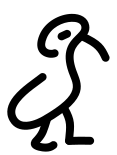
Best Guess - Bird「鳥」
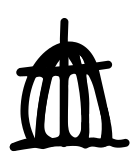
Best Guess - Cage「檻」
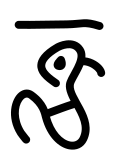
Various Guesses - Duck「縮める」 Dive「潜る」 Down「下」
For a time, I also wondered if, because the character's pose is similar to the way yoruda is found sleeping in her cage, the glyph might represent the word 'Daughter'.
But I find myself doubtful of that lately.

Best Guess - East「東」
The sun always rises in the East.
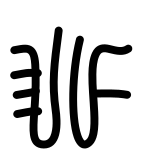
No Guess
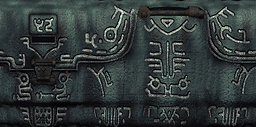
There are very similar symbols found on the sacrificial capsules.
However, I find it difficult to attribute any 'F' term to this without a pretty big stretch...
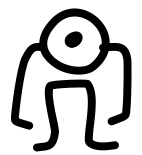
Best Guess - Giant「巨人」
It even looks like if you stacked the two kanji atop each other in a certain way.
If it's true this is 'giant', it might be referencing the cut 'enemy_l'...
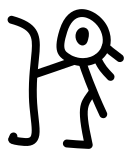
Various Guesses - Hide「隠れる」Hold「持つ」
I'm more inclined towards the former possibility, since it would reference e-koʊ hiding his full body behind the cover of the stone idols found in The Queen's throne room.
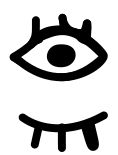
Notice it's not one structure here. You might think of that bottom half as a distant lower eyelid, but I instead offer this reading:
Top half = eye opened
Bottom half = eye closed
Best Guess - Instant「瞬時」
瞬時 [Jisho]
"instant; moment; (split) second; (in a) flash; (in the) blink of an eye."
Many native English speakers have proposed the idea that the hieroglyph above represented a singular Eye, which represented the sound native English speakers make (IPA: aɪ / Katakana: アイ) when saying "I".
But after finding this phrase amid the kanji's synonyms, and knowing 'eye' would make an exception to the established first letter rule, I very much doubt that.
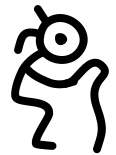
Best Guess - Janitor「守衛」
Ok, that sounds silly. Until you look at the synonyms associated with that role.
"(security) guard; caretaker; doorkeeper; gatekeeper" [Jisho]
These sound fitting of the roles that cut Castle Soldiers would occupy, in the PS1 iteration of the game.

The 老兵 (Old Soldier) was even reported, by a former developer, to have been responsible for menial and routine tasks around the Castle, which included cleaning, and the inspection of torches. This role sounds fitting of a janitor, and it's placed upon the eldest of the Soldier types...
ざっくまん/Zackmann⭐趣味垢
@zackmannx.bsky.social
PS1用として
・将校(赤いシャツ)
・軍曹(緑のシャツ)
・一般兵士(青いシャツ。ヨルダを連れ去ったりイコを攻撃する。e-koʊ Prototypeの動画に出てくる)
・老兵士(城の雑務、松明の点検、掃除などを行う)
以上、4種類の敵兵士を作成しました。その後、影の敵(PS2版)に変更になりました。
— Jun 2, 2025
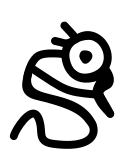
Best Guess - Kneel「跪く」
These figures can also be seen on the sacrificial capsules, albeit, with straighter backs. Perhaps the lower posture seen here is to emphasize their humility or respect? This could even be referencing a kowtow. But that would have to be much lower to be proper, at least by the standard of Asian cultures on Earth...
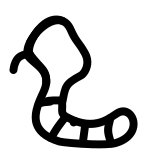
Best Guess - Larva「幼虫」
Honorable Attempt - Lure「餌」
Larva is a pretty obvious choice, but for a while I did try to imagine something different and came up with a somewhat plausible alternative. But it's still not enough to say it's the best guess...
An alternative definition for the term 餌 is: (animal) feed.
Some motion files had their Japanese descriptions recently uncovered in the files of a demo build. A bird animation (titled 'BIRD_EAT' in English) was described as: 鳥餌食べ
"Bird eating animal feed"
Potentially,the feed here could be worms.
But keep in mind that is speculation, without full context.
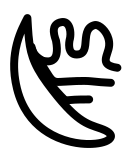
Best Guess - Moon「月」
Honorable Attempt - Molting「脱皮」
So, to explain the latter entry first, for a while I was very doubtful of the idea that the right half of the image was a cloud. I thought such an idea was unneccessary to convey the subject of 'moon' and so I tried to interpret the image from an entirely different angle. In doing so, I strayed too far, but did find a lot of cool trivia to share. And for that reason, I will talk about it anyway.
A quote from one of Fumito Ueda's interviews kicked off my insect molt theory:
--Tell us something about yoruda, e-koʊs companion, that we don't already know.
"She wears a white dress [...] it's also inspired from the white, transparent form that cicadas take when they come out of their shell." -Fumito Ueda, Glixel Interview
I knew it wasn't just cicadas on his mind during the development of e-koʊ. The Shadow Creatures have names given in the game's files.
Imomushi (caterpillar), Tyou (butterfly), and Umiushi (nudibrach) stood out to me. There's a thread tying some of these concepts together:
Caterpillars develop a chrysalis that they must shed in order to become butterflies. And nudibranches must shed their shells after their larval stage. These elements all pointed to ecdysis.
So I wondered if that 'moon' was a crescent shaped pupa or chrysalis, with something emerging from it at a 90° angle.
This was, of course, too high concept, and I found a simpler explanation existed in cut content, briefly touched on in a discussion about Shadow of the Colossus.
The way light is expressed is also impressive.
Ueda: The world in the game actually does have night as well as day. I’d wanted to have time and weather variations ever since making e-koʊ, but it’s another thing that was cut due to memory issues.
-'Expressing the Enormity of the Ancient Lands' from The Graphic Designers Tell It Straight an extended interview translated by Glitterberri
Ueda's quote gives some credence to a specific file still left with the game. Among limited cloud assets under the folder "sky_dark", there's a model called "moon_fog" (this folder is distinct from "sky_rain" which contains the majority of raincloud and lightning assets for the final act).
But of course, there's no actual moon in the maps that moon_fog is attached to. This gives me the impression, however, that when e-koʊ awoke after being separated from Yorda, it may have originally been nighttime. If that were the case, a clouded moon would be part of the game's visual iconography...
There's also a phrase in Japanese that may or may not relate to this visual:「月に叢雲花に風」
A proverb sometimes translated as: "the moon covered by clouds, flowers scattered by winds". Its meaning: Good things don't last forever.
Evoking such a phrase would be very fitting of the moments after e-koʊ and yoruda have been separated.
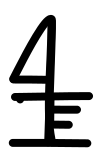
Best Guess - Navigation「航海」
The word 'navigation' is, notably, very synonymous with 'sailing' and 'sea voyage'. The prominence of the triangle as the sail is what drew me to this particular reading.
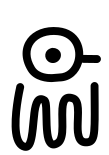
Best Guess - Octopus「蛸」
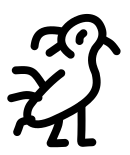
Various Guesses - Pigeon「鳩」 Peacock「孔雀」
It's clearly a different kind of bird than the one used for B, but why that seems to be distinguished with curving lines is unclear to me.
The white birds you see throughout the game coo like pigeons, and could be well-bred rock doves. So I lean towards the former.
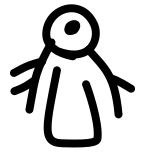
Best Guess - Queen「女王」
It's the obvious choice, due to her relevance in the narrative and fictional culture. This is also one of the tallest characters, adding to the impression.
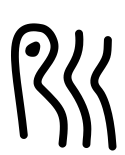
Best Guess - River「川」
This is another one that resembles the kanji in a way. As well as the English letter. I wonder if that was the intended design goal for a number of these? Though I think to consistently reference both the shape of the Japanese Kanji and the English letter was too difficult a task to ever be consistent.
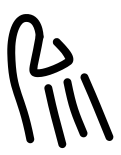
Best Guess - Shower「シャワー? / 夕立?」
I wonder if the visual was made to be interpreted literally, as the household fixture. Or if it was used to easily call the term 'Shower' to mind, when they meant it as sudden rainfall (夕立). Like the one that occurs in the game's final act.
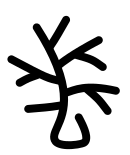
Best Guess - Tree「木」
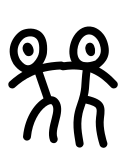
Best Guess - Union「団結」
Synonyms: "unity; solidarity; combination; banding together; teaming up"
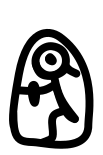
Best Guess - Victim「生贄」
The term for "living sacrifice" in Japanese, used throughout the game's concepts and in the Japanese script (where it is written as イケニエ), has a secondary definition in dictionaries: "victim; scapegoat".
This depicts a child (notably small) bound within a capsule.
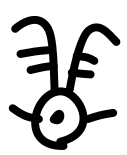
Best Guess - Wing「翼」
One of the flying Shadow Creatures shares this same kanji as its name: t[s]ubasa.
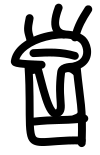
No Guess... (for English)
I have a wild theory about this one. Many of these symbols are based in existing or cut content from the game's world. So this rectangular figure couldn't be entirely unrelated to the world of e-koʊ. I had to have seen something like this before.
But the closest image from the game my mind could draw upon were the Idols (referred to as 石像 'sekizou', literally 'stone statues', in development). And there's no way to make a synonym for statue or idol that starts with X in English.
People have attempted this with the word 'Xoanon', but not only does the world of e-koʊ lack wood sculptures (even in early development, to our knowledge), this word is nowhere to be found in Japanese-to-English dictionaries. In the modern day, it doesn't even have a counterpart page on Japanese Wikipedia! It's simply too obscure to have reached the team's attention.
What I've realized since, after doing the translation work for Yorda's Language, is that this may not be an English word at all.
X at one point seems to serve as a substitute for 'sh'. The example being 'watashi' to 'xtw'. This makes sense when viewed from a Chinese language perspective. The sound of 'x' as spoken in Chinese is near identical to the 'sh' sound in English.
So if we toss out English, and utilize both a Japanese and Chinese lens to view the term used for statues in the files of e-koʊ: '(seki)zou', we find some interesting things about it.
For one, under a search for 'zou', you will find two very similar kanji of common usage: 像 and 象. You'll notice they are almost identical. The first means "image; figure; statue; picture; portrait". The second has a similar meaning, but only in its verb form 象る: "to imitate; to symbolize; to represent". In its noun form, 象 means "elephant" exclusively.
We know from the margins of concept art that 像 was the intent.
像, the Chinese character, is romanized as xiàng. That starts with an X. So perhaps, Kuwabara couldn't find a suitable English word for the letter, and turned to a language that was already influencing e-koʊs fictional languages: Chinese. And to hint towards the usage of this specific Chinese character/Japanese Kanji, he gave the idol in question a long nose, like that of an elephant, which the kanji relates to.
...All I'm saying is that it's a possibility.
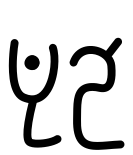
No Guess
Because this one had its meaning confirmed!
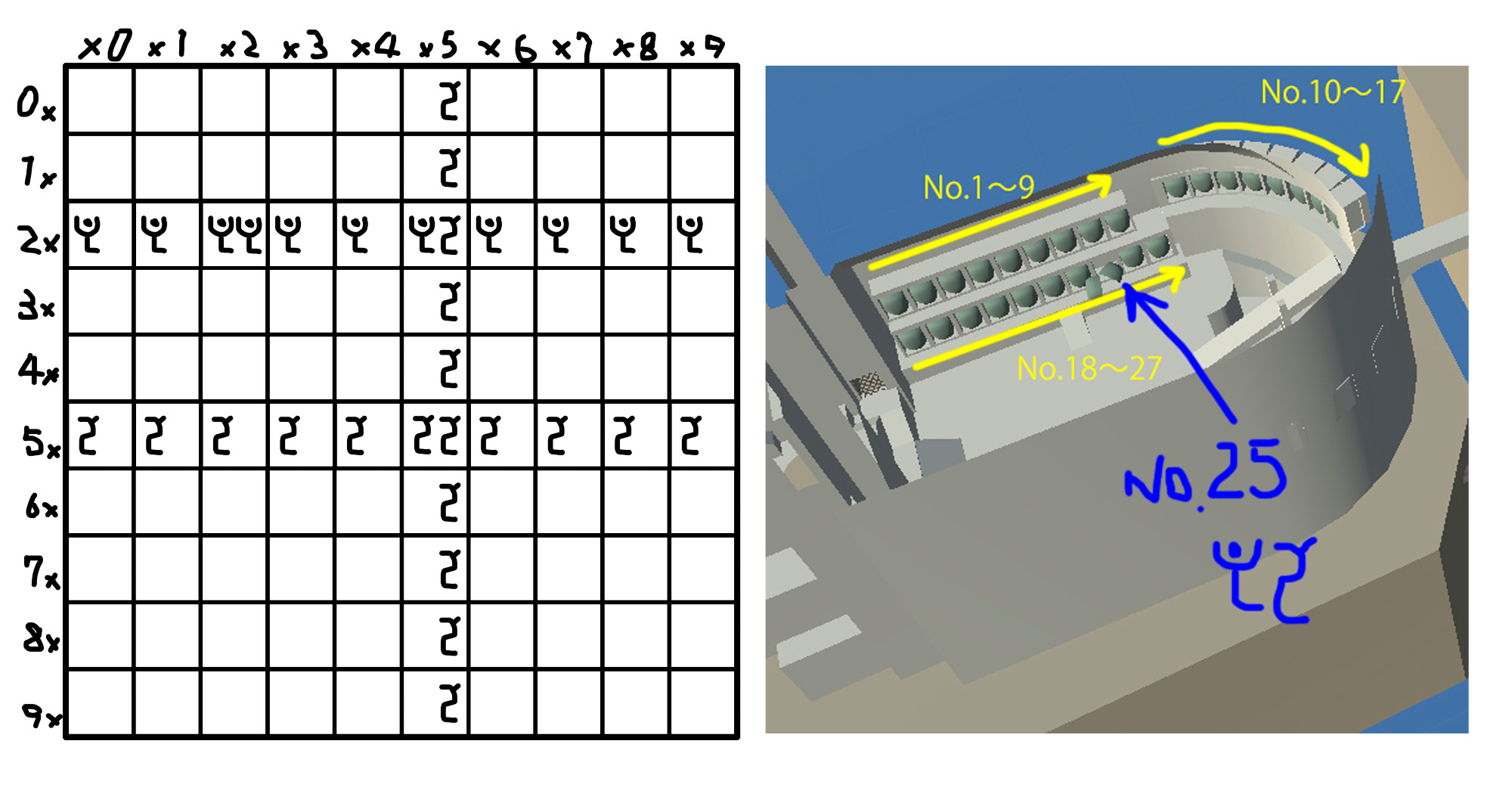
It doesn't represent anything tangible. Rather, it is part of a scrapped numerical system originally intended for the sacrificial capsules. It was the number 25, which is why it corresponds to 'Y', the 25th letter in the English alphabet.
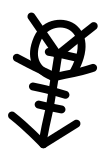
Best Guess - Zipper(?)「ファスナー」
I actually feel strongly that this somehow refers to the Reflectors, but I can't figure out a synonymous a 'Z' word for what they are or what they do.

Until I find a better answer, 'zipper' is the most fitting.
Whether I was convincing in my assessments or not, these are just my best guesses, and you are entitled to your own interpretations.
And I'd love to hear those interpretations, especially for the hieroglyphs I was left confused by.
Also, if you like the svg graphics I produced for this page, you can get them here.
